Constituency Voter Survey & Opinion Poll Agency in India
Eliminate guesswork before committing campaign crores. Multi-stage stratified random sampling, booth-wise anti-incumbency mapping, sub-caste demographic consolidation analysis, and candidate matchup simulations across Madhya Pradesh and Central India with empirical statistical rigor.
Why is a Scientific Voter Survey Critical Before an Election?
In high-stakes Indian legislative assembly (Vidhan Sabha) and parliamentary (Lok Sabha) elections, traditional feedback from party loyalists is dangerously misleading. Local sycophancy obscures growing anti-incumbency, infrastructure dissatisfaction, and shifting caste alignments. When party workers assure a candidate of an "easy win," they are often measuring the enthusiasm of their own committed base while remaining oblivious to the silent majority of undecided voters.
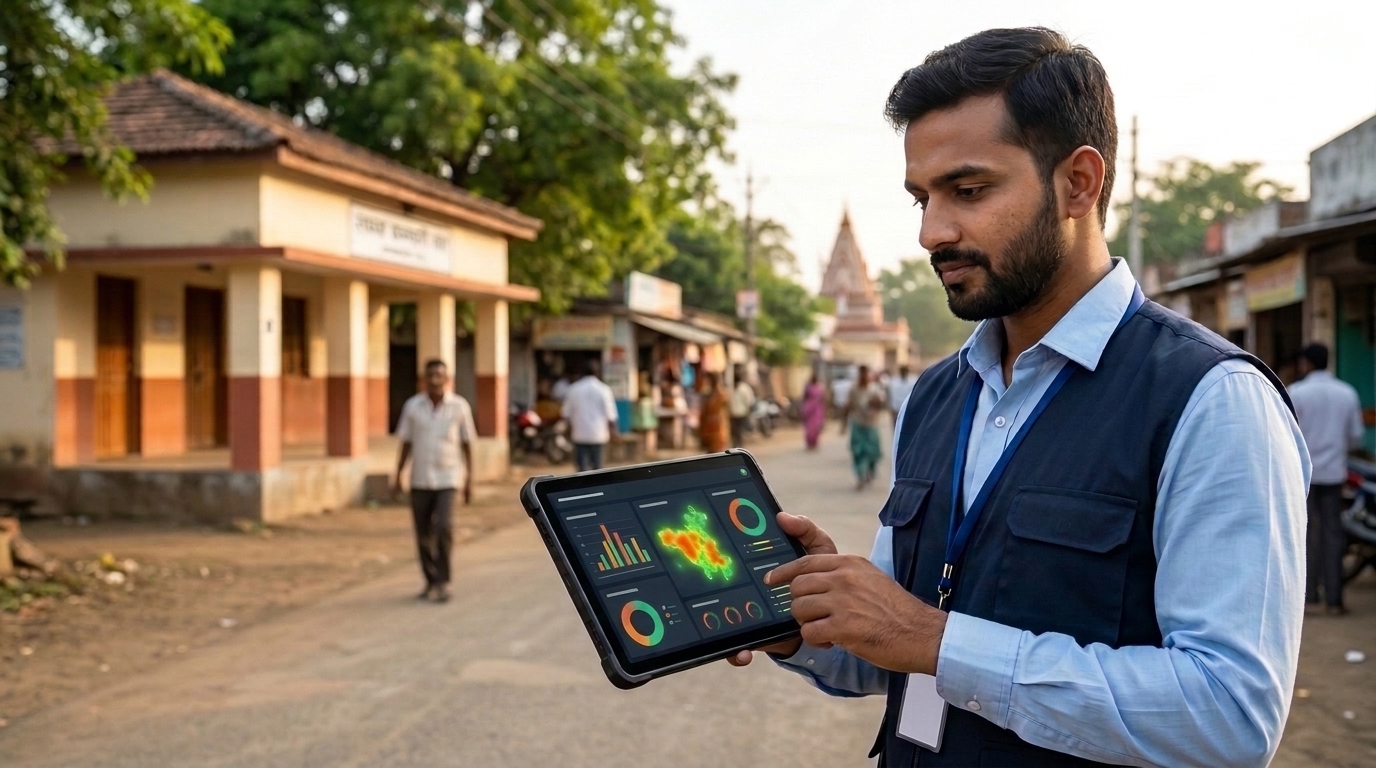
FutureTech Digital Marketing Agency deploys an empirical research methodology supervised by Chief Political Strategist Jagmohan Kurmi. Using multi-stage stratified random sampling, GPS-geotagged digital survey tablets, and audio-verified quality checks, we deliver deep psephological intelligence that empowers candidates to deploy resources with surgical precision.
A professional opinion poll is not merely about finding out who is winning today; it is about discovering why voters are leaning in a particular direction and identifying the specific levers—caste outreach, local developmental promises, or counter-narratives—that will shift uncommitted voters into your victory column by polling day.
Our 4-Stage Political Survey & Polling Suite
Baseline Feasibility & Ticket Viability Survey
Conducted 6 to 12 months prior to election notification. Evaluates sitting MLA approval ratings, baseline voter dissatisfaction, primary local grievances (water, roads, crop procurement, unemployment), and benchmarks the aspirant's winnability against intra-party rivals to build an undeniable empirical dossier for party high-commands.
Booth-Wise Anti-Incumbency Decomposition
Every polling station is audited to decompose voter sentiment. We separate candidate-specific anti-incumbency from state or national party fatigue using 5-point Likert scale questionnaires. Categorizes booths into Fortress Booths (>55%), Swing Booths (40%–50%), and Vulnerable Opposition Strongholds (<35%).
Head-to-Head Candidate Simulation & Message Testing
Once party nominations crystallize, we conduct head-to-head matchup polling. We test specific campaign narratives, promises, and contrast messages across demographic cohorts to determine which issues create maximum voter shift in critical bellwether wards.
Exit Polling & Post-Poll Turnout Reconciliation
Conducted strictly on polling day in compliance with Section 126A of the Representation of the People Act, 1951. Sampled voters are interviewed outside the 100-meter perimeter immediately upon voting. Provides campaign directors with accurate turnout projections hours before EVM counting begins.
Psephological Rigor: Statistical Sizing & Sampling Matrix
We adhere strictly to multi-stage stratified random sampling principles. The table below outlines our statistical sample sizing models tailored for Indian elections:
| Electoral Unit | Total Electorate | Recommended Sample | Confidence Level | Margin of Error |
|---|---|---|---|---|
| Municipal Ward / Nagar Parishad | 8,000 – 15,000 | 400 – 600 Voters | 95% | ±3.5% |
| Vidhan Sabha (Assembly Seat) | 200,000 – 260,000 | 1,800 – 2,400 Voters | 95% | ±2.2% |
| Lok Sabha (Parliamentary Seat) | 1,600,000 – 2,000,000 | 6,500 – 8,000 Voters | 95% | ±1.8% |
Field Technology: Anti-Fraud Algorithms and Quality Control
The greatest danger in commercial opinion polling is "couch-surveying"—where lazy field interviewers sit in hotel rooms and fabricate responses. FutureTech enforces a multi-tiered technological defense system:
Continuous Geofence Radius Locking
Field surveyor tablets are locked to specific polling booth geographic coordinates. If an enumerator attempts to record a questionnaire outside the designated booth boundary, the application freezes and flags the survey as invalid.
Randomized Audio Snippet Verification
With voter consent, the application records randomized 15-second audio snippets during key questions. Our quality control desk in Sagar audits 20% of all submitted audio files to confirm genuine conversation with authentic local vernacular accents.
Speed-Run Rejection Algorithms
A comprehensive 24-question survey requires an average of 8 to 12 minutes. Any interview submitted in under 4 minutes is automatically rejected by our server algorithms as fraudulent speed-running.
Telephonic Back-Check Audits (15% Sample)
Our central call center in Sagar calls back 15% of all surveyed voters within 24 hours to verify: Did the interviewer physically visit your house? Did you answer these questions? This ensures 100% data authenticity.
Turn Survey Data into Polling Day Ballots
Survey findings should not gather dust in a presentation slide. Connect survey insights directly to our 24/7 Digital Election War Room Hub and deploy personalized solutions via our WhatsApp Voter Outreach Automation.
Frequently Asked Questions: Constituency Voter Surveys & Opinion Polls
What is the recommended sample size for a Vidhan Sabha constituency?
For an assembly constituency of 200,000 to 250,000 voters with 250 to 300 polling booths, a robust sample size ranges between 1,800 and 2,500 respondents (averaging 6 to 10 interviews per polling station). This delivers a 95% statistical confidence level with a margin of error within ±2.5%.
How long does a full constituency survey take to execute?
A standard 2,000-sample assembly survey requires 7 to 10 days of field data collection using a team of 15 to 20 trained field researchers. Data cleaning, statistical weighting, and cross-tab report generation take an additional 3 days, delivering the final strategic dossier within 12 to 14 days from contract signing.
Are your survey methodologies compliant with Election Commission of India rules?
Yes. All pre-poll surveys are conducted strictly as confidential internal campaign intelligence. Furthermore, our post-poll and exit survey protocols adhere 100% to Section 126A of the Representation of the People Act, 1951, ensuring no findings are publicized before the final phase of voting concludes.
How do you capture caste equations without triggering social friction?
Our enumerators are recruited locally and trained in neutral sociological interviewing techniques. Caste demographic information is collected alongside standard socio-economic indicators (occupation, landholding, education) near the end of the survey, ensuring voter comfort and authentic reporting.
Can survey results help in ticket distribution negotiations?
Absolutely. Party high-commands frequently commission or demand empirical feasibility reports before finalizing candidate lists. Our benchmark survey provides hard data demonstrating your personal popularity, cross-community acceptance, and winnability margin against rival claimants.